To the church without a pastor…

It is estimated that there are roughly 30,000 evangelical protestant churches in the United States without pastors. This number of churches likely represents approximately 2,000,000 people who are without a pastor. The church that I pastored for 15 years in Illinois went almost 3 years before finding a new pastor. The church I attended in North Carolina went around a year and a half without a pastor. The church I currently pastor went a very short time – about 6 months – before I came (it hardly counts since I had such a personal connection to the church – my dad started this church). Pastor-less churches are a major problem in the United States.

It was a problem in at least one of the N.T. epistles as well. The structure of 1st Corinthians indicates that the church in Corinth sent a list of questions to the Apostle Paul with the last one being a request that he might send Apollos back to them – which request Apollos declined (1st Corinthians 16:12). Paul therefore encouraged the church, that in the absence of Apollos, they should submit themselves to the leadership of the family of Stephanus, who were likely the deacons in the church (1st Corinthians 16:15-16).

The Lord intends for churches to have pastors. They are gifts given to the church as stated in Ephesians 4:8-11. Timothy and Titus were both instructed in the selection and perpetuity of men working in that ministry. However, as Corinth demonstrated, there are times that a New Testament church is without the God-ordained shepherd.

The foundation for the title of pastor is shepherd. The designation is given generically to the New Testament church only a few times, but those are significant. I’ve already mentioned Ephesians 4:11 (this is a noun). The other two places are in Acts 20:28 (verb), Paul encouraged the Ephesian elders to “feed the church of God” and in 1st Peter 5:2 (verb), Peter encouraged the elders in the various churches to “feed the flock of God.” Both of those phrases come from a verbal idea meaning “to pastor or shepherd.” One other reference of note is in John 21:16, after His resurrection and during that searching conversation by the Sea of Galilee, Jesus had previously told Peter to “feed My sheep.” Again, this is the same word “to pastor.” I suspect that Peter had the words of Jesus in mind when he repeated them to the other elders in 1st Peter 5:2.

The imagery of shepherding people preceded the New Testament church; it also supersedes human pastors. Jesus has habitually referenced Himself as the Shepherd of His flock. In Matthew 9:36 and Mark 6:34 (two different contexts), Jesus was moved with compassion because the people were “as sheep having no shepherd.” In Matthew 26:31 and Mark 14:27, Jesus quoted Zechariah 13:7 and predicted “smite the shepherd, and the sheep shall be scattered” to tell the disciples what would happen at His crucifixion. Luke 12:32 and Matthew 25:32, both prophecies of the Second Coming of Jesus, use shepherding imagery when Jesus says “fear not little flock” and also that a shepherd divides the goats from the sheep. Finally, a fascinating description is given in Revelation 2:27, 12:5, and 19:15 of Jesus ruling with a rod of iron. The word “rule” is the same word for “shepherding.”

The point is this: Jesus shepherds His people. So, while a New Testament church may be with out a human shepherd, it is never without The Divine Shepherd. There are 4 very comforting passages of Scripture in the New Testament which describe the kind of Shepherd that Jesus is for His people. Each of them also present a different nuance as to His watchcare over His people.

John 10:11 – The Good Shepherd

I have preached weeks of messages from John chapter 10. I’m not going to write a commentary on the passage here, but point out that in verse 11, Jesus the Shepherd is emphasized with the adjective “good.” “I am the Good Shepherd: the Good Shepherd giveth His life for the sheep.” Obviously, this word has a very broad meaning; several lexicons have synonyms such as beautiful, whole, morally good, praiseworthy, healthy, etc. However, the context (10:1-18) sheds much light on what Jesus meant when he referred to himself as the Good Shepherd. First, Jesus contrasted Himself with thieves, robbers, strangers, and hirelings. Jesus is none of those things. Secondly, Jesus described Himself as the One who gives His life for the sheep; He protects His sheep and will not flee when the wolf comes, He knows His sheep and is known by them, His sheep hear His voice – meaning He communicates with Him, and He is increasing His flock!

The contrast in context is what reveals Jesus as “the Good Shepherd.” Though there are many good under-shepherds, there are none the compare to Jesus. Find comfort in knowing that even though you may be without an earthly shepherd at the moment, the Good Shepherd is free from the defects of humanity and will never fail you. Further more, He has already given His life for you, He knows you, He communicates with you through His Word and by His Spirit – so hear His voice!

Hebrews 13:20 – The Great Shepherd

The context of the book of Hebrews has always fascinated me. These Jewish Christians were anticipating persecution at the hands of the Romans. At this brief juncture in history, though Judaism had an on and off relationship with the permissiveness of the Romans, Judaism was a safer religion than Christianity.  (If this interests you, Josephus records the permissions granted to Jews and Tertullian refers to the religio licita [legal religion] and to the religio illicita [illigal religion], this second designation the Christians eventually possessed.) The Christian Jews anticipating persecution considered the possibility that reintegrating into Judaism would spare them persecution and then after the persecution had passed they could reclaim Christ.  The author of Hebrews made it very clear that was not a valid option.  His point was to demonstrate the superiority of Christ’s person and work and therefore the Christian walk of faith – to all things Jewish and Old Testament.  The epistle, of course, ends with practical exhortations.  In 13:7 and 17, the author of Hebrews refers to those who are ruling (human pastors), but then in verses 20-21, He issues a salutary desire and prayer, “now the God of peace, that brought again from the dead our Lord Jesus, that Great Shepherd of the sheep, through the blood of the everlasting covenant, make you perfect in every good work to do His will, working in you that which is well pleasing in His sight, through Jesus Christ; to whom be glory for ever and ever. Amen.”  The prayer is that God, with the same power that raised Jesus from the dead, would continue His work of sanctification in them.

In these verses, the author of the book of Hebrews refers to Jesus as the “Great Shepherd.” Like the word “good” from John chapter 10, the word “great” in Hebrews chapter 13 has various meanings as an adjective. Lexicons will record synonyms like large, abundant, and important. Still, it must be recognized in context. Jesus is also the great High Priest (4:14, 10:21). The entire book emphasizes the superiority of Christ to everything and everyone. This description is likely a kind comparison to the earthly leaders in 13:7 and 17, but even more, it is ending the book with the awesome description of Jesus as the superior Shepherd to all shepherds – even those who “watch for your souls” with a pure and sincere heart. Whether you have an earthly shepherd or not, you can never be separated from the Greatest Shepherd! Even if you have had a wonderfully spiritual and appreciated pastor, he will never compare to Jesus.

In a book that describes Jesus as superior to the prophets, the angels, Moses and the old covenant, the Levitical priesthood and system, the old sanctuary – the last way He is described is the “Great Shepherd.” This chapter also says in verse 8 that He “is the same yesterday, and to day, and for ever.” The same Great Shepherd that kept His flock through Nero’s persecutions is the same Great Shepherd who will keep you through this time without an earthly pastor.

1st Peter 2:25 – The Gracious Shepherd

The context of 1st Peter is not much different than that of Hebrews, specifically Jewish Christians living in anticipation of external persecution. Peter wrote to these believers to help prepare them to have submissive hearts – as Jesus did in His sufferings. The section began in 2:13; these believers were instructed to submit to the king, to governors and to their masters (13-18). Then they were told to make sure that if they suffer, it was on account of Christ and not because their faults (19-20). Peter described the sufferings of Jesus and reminded them that He was their example for suffering (21-24); these verses concluded with imagery from Isaiah 53 and the same begins verse 25, “ye were as sheep going astray.” Peter took that quote from Isaiah 53 and transitioned it into application for the Christians to whom He was writing.

These people had been wondering sheep, but now had been turned back to the Shepherd and Bishop of their souls. In the grammatical structure, the Shepherd and Bishop are the same entity. The word “bishop” quite literally means “overseer.” In contrast to the king – like Nero, or the governor – like Pilate, or the slave owner – who persecuted or controlled their life, this Shepherd/Overseer had turned their souls toward Himself. To bring about the turning of their souls, He never sinned, He had committed Himself to God in suffering, and most graciously had born their sins in His body on the tree and had taken stripes for their healing. He made possible the change in their lives.

No earthly leader ever could show the grace that was demonstrated by the overseer of our souls. Though Christian leaders are supposed to be ministers of grace, we are only the channels of the grace of God to others. The Shepherd which we possess is the Overseer of our souls who has ministered on our behalf to turn our hearts to Himself.

As the Overseer of our souls, He is also a Guiding Shepherd.

1st Peter 5:4 – The Governing Shepherd

The 4th and final description of the Shepherd is also found in 1st Peter. Peter here speaks to the elders of these scattered believers and churches in 5:1-4. He began by exhorting them to “feed the flock of God which is among you, taking the oversight thereof, not by constraint, but willingly; not for filthy lucre, but of a ready mind; neither as being lords over God’s heritage, but being examples to the flock.” Verse 4 concluded the instruction with a promise of the reward that would be given to these kinds of faithful under-shepherds – an unfading crown of glory. The reward would be given by the Chief Shepherd – and here we have the last description of Christ as Shepherd.

Literally, this is the Arch Shepherd. He is in charge of all others. He is the One who gifted and enabled all others. He is the One Who – as the previous verses demonstrate – created the job responsibility for all others. He is the One to whom all others are accountable. He is observing the way that under-shepherds are taking care of His flock.

Matthew chapter 16 informs us that Jesus will build His church; Ephesians 4 teaches that Jesus supplies His church with pastors that He gifted for their work. 1st Peter 5 teaches us that the Chief Shepherd will return and the under-shepherds will be accountable to Him. The work of pastoring is so important to the Chief Shepherd that He is keeping track of how under-shepherds do and that He will reward them (or withhold reward) for the way that they labored on His behalf. In other words, for the believer, know that Jesus is watching how you are being shepherded. When you get a new earthly shepherd, Jesus is watching. It is His church and He cares who is doing that work and how they are doing.

Conclusion:

Jesus is the good Shepherd Who, unlike an hireling, gave His life for you. He loves you, He knows you, He communes with you.

Jesus is the great Shepherd Who is superior to all others. Not only is He superior to prophets, to angels, to Moses, He is also superior to all other shepherds.

Jesus is the gracious Shepherd Who, as the Bishop of your soul, turned you from a wondering sheep to Himself.

Jesus is the governing Shepherd Who is observing all the shepherding that is taking place by His under-shepherds; He cares how you are being shepherded and will reward those who do it in a manner that is pleasing to Him.

You may be without a human shepherd for a period of time, but you are never without the good and great Shepherd.

I think of the words of David in Psalm 23, the LORD is my Shepherd…

Choose Your Battles…

I remember my mother telling me years ago to “choose my battles.” She was giving me advice relating to my parenting and on hindsight, I wish I would have applied her suggestion a little more specifically. As I think back to my teen years, I realize that there were things which my parents realized were not worth a fight and that they let us have our own way with some things, even though they weren’t in agreement with what we were doing. They knew that a way to alienate us as children was to tell us “no” all of the time or to constantly be nitpicking over minor things. Now that I have children that have passed from adolescence through the teen years and into adulthood, I realize the patience which my parents exercised – and also the faith. I also wonder how I should have done differently as a parent and how my children may have profited had I not made mountains of mole hills.

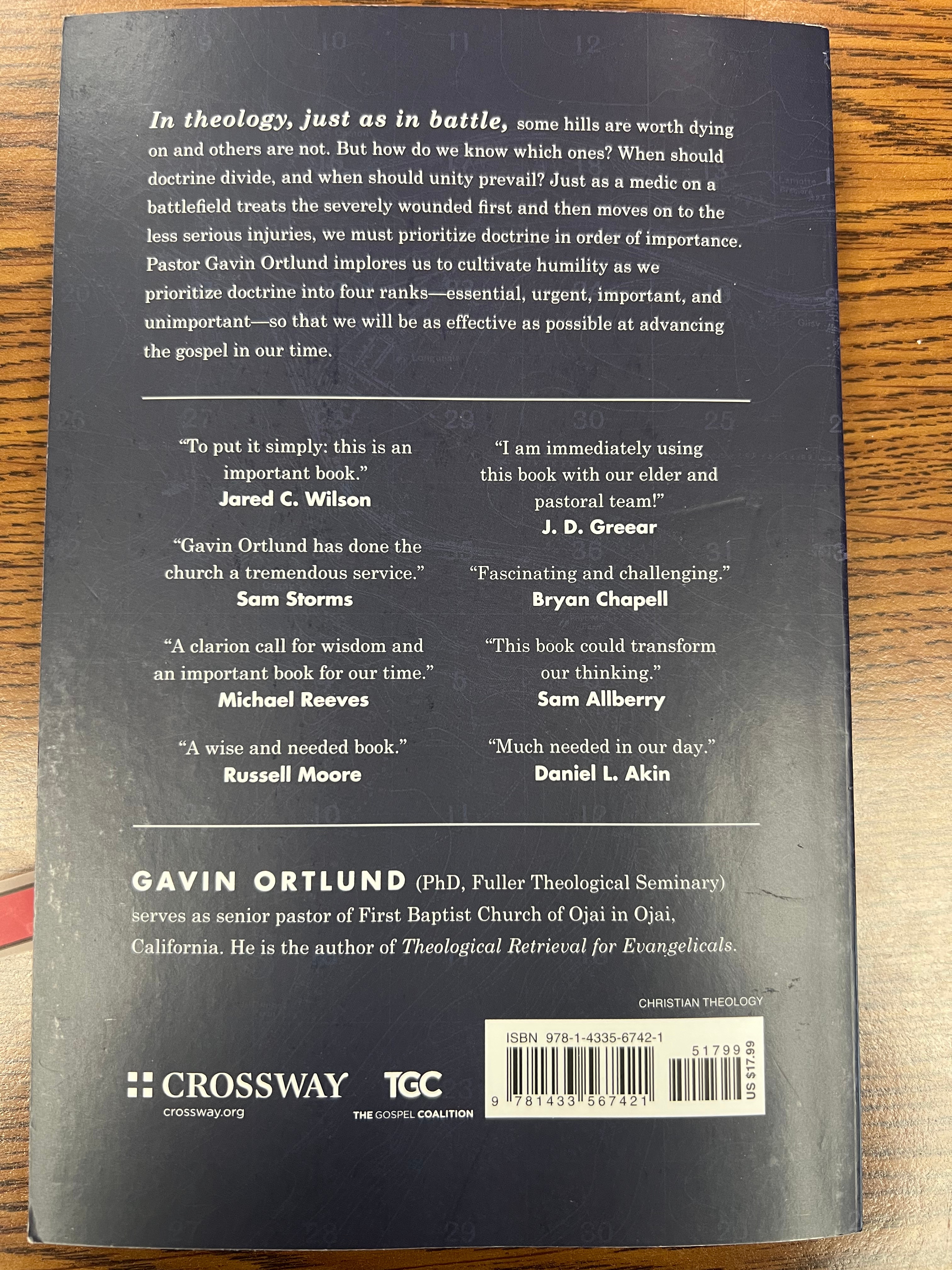
However, this post is not about parenting. A couple of weeks ago I read Gavin Ortlund’s book “Finding The Right Hills To Die On – The Case for Theological Triage“.

Gavin Ortlund is the pastor of First Baptist Church of Ojai, CA. He has written a couple of other books as well. (“The Art Of Disagreeing – How To Keep Calm And Stay Friends In Hard Conversations” is supposed to arrive tomorrow). This was an excellent and much needed book. I didn’t agree with everything, we would agree on the fundamentals, but there were some areas which I believe he and I would perhaps choose different hills, but the principles apply none the less. (I do have a hard time with the title, grammatically it should be “Finding The Right Hills On Which To Die” – but that is not a hill on which I’ll die.)

The back cover explains the theme of the book.

Ortlund first ranks doctrines into 4 different categories: “First-rank doctrines are essential to the gospel itself. Second-rank doctrines are urgent for the health and practice of the church such that they frequently cause Christians to separate at the level of local church, denomination, and/or ministry. Third-rank doctrines are important to Christian theology, but not enough to justify separation or division among Christians. Fourth-rank doctrines are unimportant to our gospel witness and ministry collaboration.” I’m certainly not bound to his categories, but they do give much food for thought and a paradigm by which to begin.

Before going any further, I’ll insert that I’m convinced that some of the things over which Christians fight are actually not even doctrines. When the Pharisees challenged Jesus that his disciples were eating without washing their hands, Jesus pushed back and quoted Isaiah 29:13 and applied it to the Pharisees saying that they taught as Biblical doctrines those things which were actually just the commandments or traditions of men. There are many things which are presented as doctrine, which would be hard pressed to pass the litmus of genuine doctrine.

Back to the book.

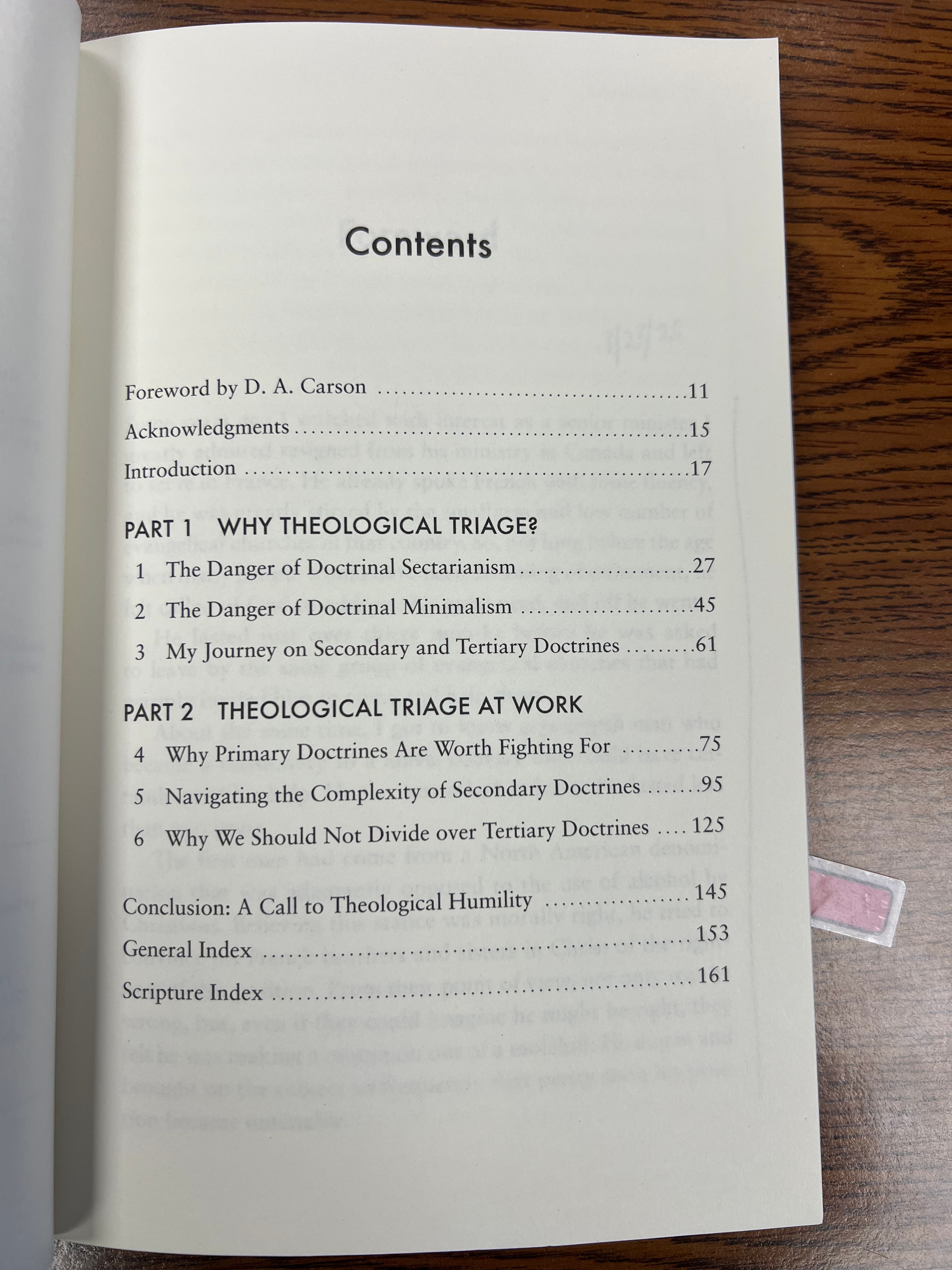
I’ll share an overview of each chapter and some of the more poignant quotes from the book.

The first sentence in the introduction is “There’s an old saying (I can’t remember where I heard it): ‘There is no doctrine a fundamentalist won’t fight over, and no doctrine a liberal will fight over.'” It is a bit hyperbolic, but the caricature is certainly recognizable.

“The problem with making every error a heresy is that it ‘renders union more difficult.'” This quote comes in chapter 1, The Danger of Doctrinal Sectarianism. In seeking to identify some doctrines which unnecessarily divide, Ortlund quotes John Calvin commenting on those who have differing interpretations as to the immediate dispensation of the soul at death, “Calvin insists that such differences of opinion would not be a source of division apart from unbridled contention and opinionated stubbornness.'” Also in chapter 1 quoting Martin Lloyd-Jones from his book Christian Unity – An Exposition of Ephesians 4:1-16, Jones said “the unity of the Church is a manifestation of the perfection of the Godhead.” Ortlund comments “It is striking that Jesus correlates the kind of unity that Christians should experience with the unity he has with the Father” (these thoughts come from the prayer of Jesus in John 17). “The church’s unity is essential to the advance of the gospel around us.” Again from Ortlund, “Much doctrinal separatism stems from finding our identity in our theological distinctives when we should be finding it in the gospel. As John Newton wisely warned, ‘self-righteousness can feed upon doctrines, as well as works!’.” These are all from chapter 1.

In chapter 2, The Danger of Doctrinal Minimalism, Ortlund shows that everything in Scripture is important. He starts with well-worn assertion “in essentials unity; in nonessentials liberty; in all things charity.” However, downplaying doctrines can also be dangerous. He now asserts 4 thoughts regarding the danger of minimizing doctrine. 1) Nonessential doctrines are significant to Scripture. 2) Nonessential doctrines are significant to church history. 3) Nonessential doctrines are significant to the Christian life. 4) Nonessential doctrines are significant to essential doctrines. He concludes chapter 4 by stating that “There is a time to fight over doctrine.”

Chapter 3 is a description of his own theological journey.

Chapter 4 takes the criterion for determining ranks of doctrine from 2 other authors, Erik Thoennes and Wayne Grudem; Ortlund reduces both of their lists and simplifies it to these 4 questions: 1) How clear is the Bible on this doctrine? 2) What is the doctrine’s importance to the gospel? 3) What is the testimony of the historical church concerning this doctrine? 4) What is the doctrine’s effect on the church today? This chapter relates to what he calls primary doctrines.

In this chapter Ortlund also explains that we must learn to recognize the difference between what must be affirmed and what must not be denied. We must distinguish what must be affirmed when someone becomes a Christian and what must be affirmed as characteristic growth in Christ over time. There must be a delineation between confused sheep and active wolves. (I think each of these can be expanded.)

Also in chapter 4 he discusses as examples the virgin birth and justification by faith alone.

In chapter 5, the focus is on wisdom and balance for secondary doctrines. He explains these as “their denial does not generally constitute a denial of the gospel. Second-rank doctrines are not essential to the gospel, but they are often important enough to justify divisions at the level of denomination, church, or ministry.” In this chapter for examples he discuses paedo-baptism and credo-baptism, spiritual gifts, and women in the ministry (complementarianism or egalitarianism). He discusses the difficulty of ranking secondary doctrines. He explains 3 reasons why they are hard to rank: 1) they don’t exist in a vacuum, 2) their interpretation often depends on context and usage, 3) doctrinal attitudes are also in play. Near the end of chapter 5, he makes this point “theological wisdom, like all forms of wisdom, is more a spiritual matter than an intellectual one.”

Chapter 6 relates to 3rd order doctrines. He lists 2 which he does not believe should be fought over (the millennium and the length of creation – and I know that he just lost some of you). Regardless of whether you consider those to be tertiary or not, there are some things that are not worth fighting over. Here is the conclusion to chapter 6: “So often, in life and theology… to avoid a fight takes a deeper and nobler strength than to engage in one… Doctrinally serious Christians must remember this…We should eagerly pursue the kind of theological conviction and strength that is willing not only to fight for the truth, but also to avoid fighting in order to promote the gospel. This is the best kind of strength.”

The book concludes with a “Call To Theological Humility.” He quotes Augustine when he was asked what it meant to do theology in the way of Christ, his explanation was “first humility, second humility, third humility.” Ortlund stated “our zeal for theology must never exceed our zeal for our actual brothers and sisters in Christ.” “The reality is that if you think for yourself, you will likely, at some point or another, hold to a different view than is socially convenient.” And so, there are 4 suggestions Ortlund gives when you have a theological disagreement: 1) be honest, 2) be tactful, 3) be gracious, 4) put your trust in the Lord.

I’ve personally wrestled through many more theological issues with brothers and sisters in Christ than I should have. Since Jesus said that it was by our love one toward another that men would know that we were His disciples, I wonder how many people have been turned away from the gospel because Christians have been so needlessly divisive over certain so called doctrines.

You won’t agree with everything in this book (I didn’t), but it should make you evaluate your approach to areas of disagreement and set a paradigm by which you’ll decide to either fight or abstain.

All the counsel of God

The apostle Paul told the Ephesian elders that he had not shrunk back from declaring to them all the counsel of God (Acts 20:27). He told Timothy, who was pastoring the church in Ephesus, that “all Scripture is given by inspiration of God, and is profitable for doctrine, for reproof for correction, for instruction in righteousness…” (2nd Timothy 3:16). When Jesus was tempted by Satan in the wilderness, He quoted Deuteronomy 8:3 to Satan and told him “it is written, man shall not live by bread alone, but by every word that proceedeth out of the mouth of God” (Matthew 4:4). There are a multitude of verses throughout the Bible expressing the value and necessity of the Word of God in a believer’s life; to reference each one in this article would turn it into a dissertation in practical sanctification.

I’ve often wondered “how many believers actually have heard all the counsel of God?” Some older believers have undoubtedly heard all the counsel of God, but I would venture a pretty experienced pastoral guess that many, if not most Christians have never been all the way through the Bible, either on their own or in church. Why is this? I think there are 3 primary reasons that a professing Christian could go through life and never know all the counsel of God.

First, some preachers do not preach expositionally. This article is not intended to be a full explanation of expositional preaching, but expositional preaching is systematic, verse by verse, explanation and application of the various books of the Bible. Many pastors and denominations do not use this method of preaching. It would be nearly impossible to preach all the counsel of God using as a primary method any other form of preaching than exposition.

When I think of Paul’s phrase in Acts 20:27, the words that he used indicate that he had been assertive to deliver the entire message of God’s purpose and will to them. Generally, Paul’s statement here is recognized as a precedent for systematic and comprehensive preaching/teaching. It would be difficult to declare all the counsel of God by any other way.

As I think about the ministry of preaching and teaching to which God has called me, the systematic and comprehensive proclamation of all of God’s Word is a lifelong ministry task. I have preached an overview of every book of the Bible and I have preached verse by verse through at least 25 books of the Bible (of 66) in a little more than 20 years of pastoral ministry; this type of preaching has typically been 3 times a week. If the Lord gives me another 20 or 25 years of ministry, it could take that much time to preach/teach substantively through all the counsel of God.

Expecting to preach all the counsel of God without using a systematic approach is about the same as trying to paint the exterior of a house with 2 inch brush while blindfolded and expecting to cover everything.

Secondly, lack of faithful attendance to church in which the Bible is preached will deprive many of the opportunity to hear all the counsel of God. Even with many churches now making their services available through either livestream or recordings, the digital statistics are quite clear that the numbers of those who are missing services are not watching them online. Digital technicians have a pretty accurate number of how many people are listening or watching, and the number is not anywhere near those who are not there. In a decades long ministry at a church, I’ll only have enough time to preach verse by verse through a particular book once. Furthermore, only one third of the messages I preach are going to be on Sunday morning; two thirds of the messages I preach to declare all the counsel of God are preached on either Sunday or Wednesday night. Even if someone attended every Sunday morning service, they are still not hearing all the counsel of God. Most believers go through life and never hear a full explanation and application of many parts of the life of Christ, or the epistles, or the Psalms, or the prophets, or the book the Revelation! Such a lack leaves one only partially prepared for spiritual battles, only partially equipped for ministry, only partially partaking of the things provided for life and godliness.

Thirdly, most Christians have never read through their Bible. The Ponce Foundation recently did a study that concluded that only 30% of Christians claim to have read through the Bible! Believers should not depend solely on their pastor to feed them spiritually. The ubiquity of the Bible, both printed and digital, has removed any excuse for a believer’s neglect of God’s Word. Depending on listening speed, the average time of listening through the Bible is between 35 and 70 hours. I recently calculated that I spend about 8 hours in a year sitting at one particular stoplight in my area. I spend about an hour a day in my car alone, my calculations are that I could listen to the Bible 7 times through in a given year, just in my car (depending on listening speed).

Several years ago, I read my Bible out-loud to myself in 8 weeks, by reading 2 and 1/2 hours a day. While that kind of time commitment may seem impossible for most people, the average American watches around 3 hours of television a day.

Many, if not most, professing Christians never hear or read all the counsel of God. It may be that their pastor is not preaching and teaching systematically through the Bible, it may be that they do not faithfully attend services in order to hear all the counsel of God declared, or it may be that they never read through the Bible themselves. There is not an excuse for this neglect of God’s Word.

I understand that practically there may be small gaps in someone’s Biblical diet, but it ought to be the painful exception, not the standard. If there is a gap in your Bible intake, let me challenge you to ask the Spirit of God why that is, and then ask Him to motivate you by the grace of God to “live by every word that proceedeth out of the mouth of God!” To live by every word of God, you need to hear or read all the Words of God!

I hope that you are one of the 30% that has read through your Bible; I hope that you are one who faithfully hears the declaration of God’s Word from the pulpit in your local church. The Word of God is living and life-giving! It is powerful and transformative! It is the wisdom for life as the mind of God on every subject! It extends God’s grace through His Spirit! You need it! Don’t neglect it!