

I remember my mother telling me years ago to “choose my battles.” She was giving me advice relating to my parenting and on hindsight, I wish I would have applied her suggestion a little more specifically. As I think back to my teen years, I realize that there were things which my parents realized were not worth a fight and that they let us have our own way with some things, even though they weren’t in agreement with what we were doing. They knew that a way to alienate us as children was to tell us “no” all of the time or to constantly be nitpicking over minor things. Now that I have children that have passed from adolescence through the teen years and into adulthood, I realize the patience which my parents exercised – and also the faith. I also wonder how I should have done differently as a parent and how my children may have profited had I not made mountains of mole hills.
However, this post is not about parenting. A couple of weeks ago I read Gavin Ortlund’s book “Finding The Right Hills To Die On – The Case for Theological Triage“.

Gavin Ortlund is the pastor of First Baptist Church of Ojai, CA. He has written a couple of other books as well. (“The Art Of Disagreeing – How To Keep Calm And Stay Friends In Hard Conversations” is supposed to arrive tomorrow). This was an excellent and much needed book. I didn’t agree with everything, we would agree on the fundamentals, but there were some areas which I believe he and I would perhaps choose different hills, but the principles apply none the less. (I do have a hard time with the title, grammatically it should be “Finding The Right Hills On Which To Die” – but that is not a hill on which I’ll die.)
The back cover explains the theme of the book.
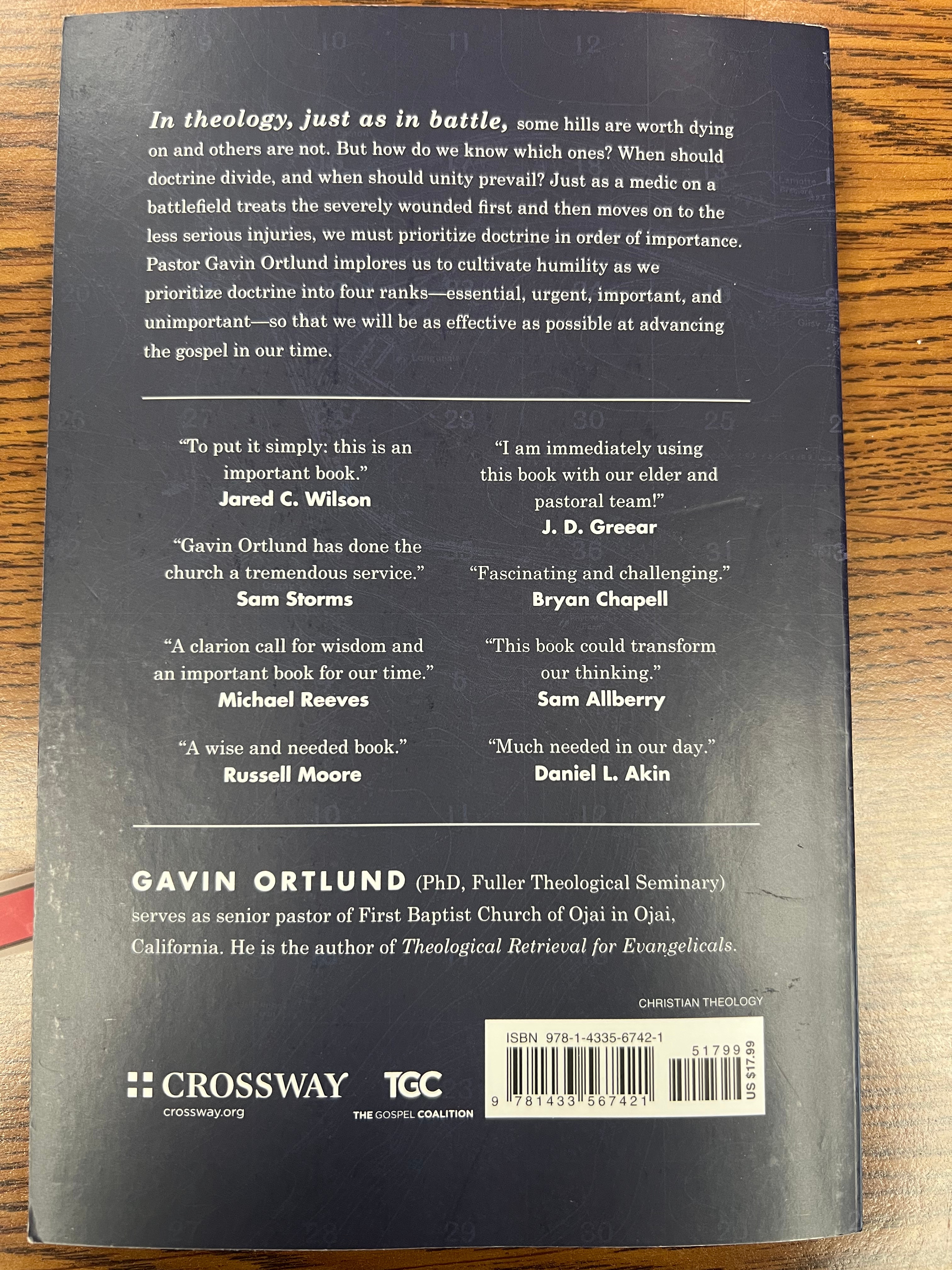
Ortlund first ranks doctrines into 4 different categories: “First-rank doctrines are essential to the gospel itself. Second-rank doctrines are urgent for the health and practice of the church such that they frequently cause Christians to separate at the level of local church, denomination, and/or ministry. Third-rank doctrines are important to Christian theology, but not enough to justify separation or division among Christians. Fourth-rank doctrines are unimportant to our gospel witness and ministry collaboration.” I’m certainly not bound to his categories, but they do give much food for thought and a paradigm by which to begin.
Before going any further, I’ll insert that I’m convinced that some of the things over which Christians fight are actually not even doctrines. When the Pharisees challenged Jesus that his disciples were eating without washing their hands, Jesus pushed back and quoted Isaiah 29:13 and applied it to the Pharisees saying that they taught as Biblical doctrines those things which were actually just the commandments or traditions of men. There are many things which are presented as doctrine, which would be hard pressed to pass the litmus of genuine doctrine.
Back to the book.
I’ll share an overview of each chapter and some of the more poignant quotes from the book.
The first sentence in the introduction is “There’s an old saying (I can’t remember where I heard it): ‘There is no doctrine a fundamentalist won’t fight over, and no doctrine a liberal will fight over.'” It is a bit hyperbolic, but the caricature is certainly recognizable.
“The problem with making every error a heresy is that it ‘renders union more difficult.'” This quote comes in chapter 1, The Danger of Doctrinal Sectarianism. In seeking to identify some doctrines which unnecessarily divide, Ortlund quotes John Calvin commenting on those who have differing interpretations as to the immediate dispensation of the soul at death, “Calvin insists that such differences of opinion would not be a source of division apart from ‘unbridled contention and opinionated stubbornness.'” Also in chapter 1 quoting Martin Lloyd-Jones from his book Christian Unity – An Exposition of Ephesians 4:1-16, Jones said “the unity of the Church is a manifestation of the perfection of the Godhead.” Ortlund comments “It is striking that Jesus correlates the kind of unity that Christians should experience with the unity he has with the Father” (these thoughts come from the prayer of Jesus in John 17). “The church’s unity is essential to the advance of the gospel around us.” Again from Ortlund, “Much doctrinal separatism stems from finding our identity in our theological distinctives when we should be finding it in the gospel. As John Newton wisely warned, ‘self-righteousness can feed upon doctrines, as well as works!’.” These are all from chapter 1.
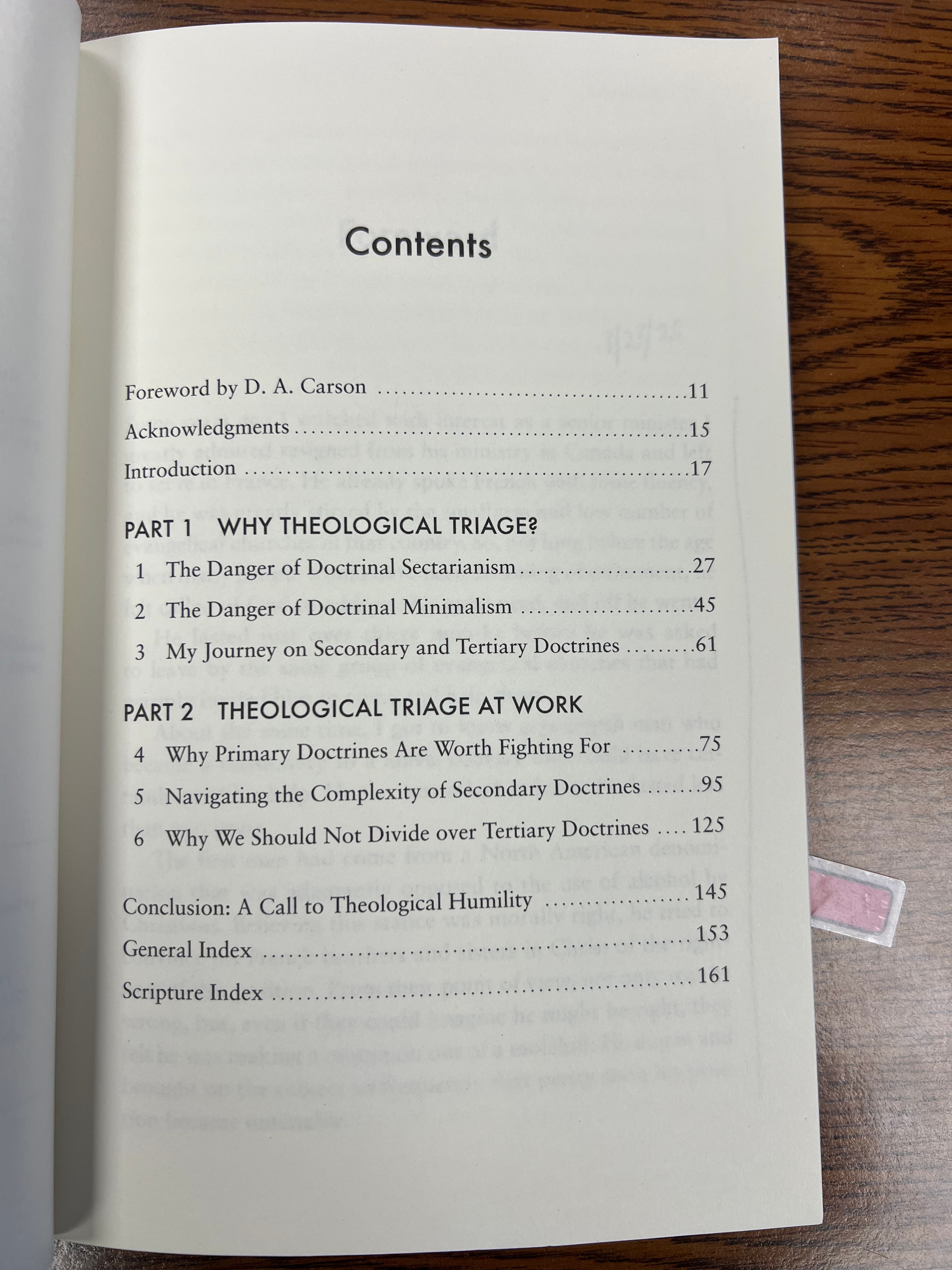
In chapter 2, The Danger of Doctrinal Minimalism, Ortlund shows that everything in Scripture is important. He starts with well-worn assertion “in essentials unity; in nonessentials liberty; in all things charity.” However, downplaying doctrines can also be dangerous. He now asserts 4 thoughts regarding the danger of minimizing doctrine. 1) Nonessential doctrines are significant to Scripture. 2) Nonessential doctrines are significant to church history. 3) Nonessential doctrines are significant to the Christian life. 4) Nonessential doctrines are significant to essential doctrines. He concludes chapter 4 by stating that “There is a time to fight over doctrine.”
Chapter 3 is a description of his own theological journey.
Chapter 4 takes the criterion for determining ranks of doctrine from 2 other authors, Erik Thoennes and Wayne Grudem; Ortlund reduces both of their lists and simplifies it to these 4 questions: 1) How clear is the Bible on this doctrine? 2) What is the doctrine’s importance to the gospel? 3) What is the testimony of the historical church concerning this doctrine? 4) What is the doctrine’s effect on the church today? This chapter relates to what he calls primary doctrines.
In this chapter Ortlund also explains that we must learn to recognize the difference between what must be affirmed and what must not be denied. We must distinguish what must be affirmed when someone becomes a Christian and what must be affirmed as characteristic growth in Christ over time. There must be a delineation between confused sheep and active wolves. (I think each of these can be expanded.)
Also in chapter 4 he discusses as examples the virgin birth and justification by faith alone.
In chapter 5, the focus is on wisdom and balance for secondary doctrines. He explains these as “their denial does not generally constitute a denial of the gospel. Second-rank doctrines are not essential to the gospel, but they are often important enough to justify divisions at the level of denomination, church, or ministry.” In this chapter for examples he discuses paedo-baptism and credo-baptism, spiritual gifts, and women in the ministry (complementarianism or egalitarianism). He discusses the difficulty of ranking secondary doctrines. He explains 3 reasons why they are hard to rank: 1) they don’t exist in a vacuum, 2) their interpretation often depends on context and usage, 3) doctrinal attitudes are also in play. Near the end of chapter 5, he makes this point “theological wisdom, like all forms of wisdom, is more a spiritual matter than an intellectual one.”
Chapter 6 relates to 3rd order doctrines. He lists 2 which he does not believe should be fought over (the millennium and the length of creation – and I know that he just lost some of you). Regardless of whether you consider those to be tertiary or not, there are some things that are not worth fighting over. Here is the conclusion to chapter 6: “So often, in life and theology… to avoid a fight takes a deeper and nobler strength than to engage in one… Doctrinally serious Christians must remember this…We should eagerly pursue the kind of theological conviction and strength that is willing not only to fight for the truth, but also to avoid fighting in order to promote the gospel. This is the best kind of strength.”
The book concludes with a “Call To Theological Humility.” He quotes Augustine when he was asked what it meant to do theology in the way of Christ, his explanation was “first humility, second humility, third humility.” Ortlund stated “our zeal for theology must never exceed our zeal for our actual brothers and sisters in Christ.” “The reality is that if you think for yourself, you will likely, at some point or another, hold to a different view than is socially convenient.” And so, there are 4 suggestions Ortlund gives when you have a theological disagreement: 1) be honest, 2) be tactful, 3) be gracious, 4) put your trust in the Lord.
I’ve personally wrestled through many more theological issues with brothers and sisters in Christ than I should have. Since Jesus said that it was by our love one toward another that men would know that we were His disciples, I wonder how many people have been turned away from the gospel because Christians have been so needlessly divisive over certain so called doctrines.
You won’t agree with everything in this book (I didn’t), but it should make you evaluate your approach to areas of disagreement and set a paradigm by which you’ll decide to either fight or abstain.
Filed under: Uncategorized | Tagged: bible, christianity, faith, jesus, theology | Leave a comment »
 Levi Deatrick
You must be logged in to post a comment.